May–Oct tends to favor movement and observation of fauna on this route, although sightings always depend on the behavior of the animals and local conditions.
NAMIBIA · NATURE + WILDLIFE
NAMIBIA — EXPERIENCE
Sixteen days crossing Namibia: dunes, the coast where the desert meets the sea, shipwrecks, six-thousand-year-old engravings and Etosha.
DURATION16 days
BEST TIMEMay–Oct
EXPERIENCENature + Wildlife
COUNTRYNamibia
THE JOURNEY
Route map
Sossusvlei → Swakopmund / Walvis Bay → Skeleton Coast → Damaraland / Twyfelfontein → Etosha
The map loads when you reach this section.
FEATURED
Key highlights
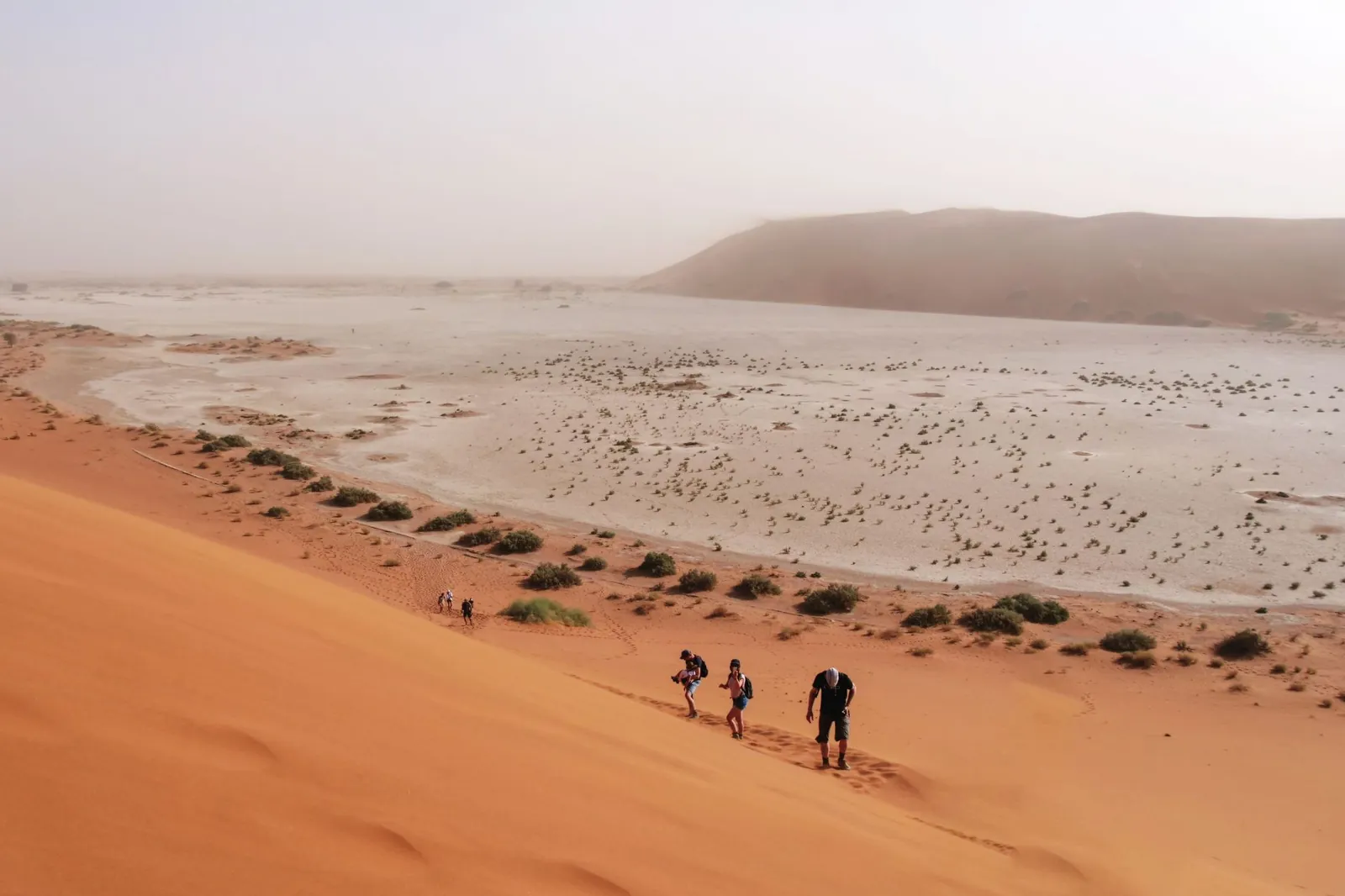
1Deadvlei and the dunes of Sossusvlei
2Sandwich Harbour, where the desert meets the sea
3Shipwrecks of the Skeleton Coast
4Twyfelfontein engravings
5Black rhino tracking
6Etosha Safari
Few countries show so much variety in one route: the world's oldest wilderness, a wild coastline, and one of the largest populations of free-ranging black rhinos. Namibia is also a pioneer in community conservation, and many lodges are run with local communities.
SEASONALITY
When to go
A STARTING POINT
Suggested base itinerary
DAY 1
Arrival and heading to the desert
Reception in Windhoek and road to the Sossusvlei region, crossing the plateau and the mountains. Arrival at the lodge in the desert at the end of the day.
DAY 2
Dune 45 and Deadvlei
Dune 45 at dawn, Deadvlei and its dead trees on the white ground, and the Big Daddy dune for those who want to climb higher.
DAY 3
Sesriem and starry sky
The Sesriem Canyon, a balloon option over the dunes and, at night, one of the darkest skies on the planet.
DAY 4
Sossusvlei → Swakopmund
Road through the canyons of Kuiseb and the Tropic of Capricorn to Walvis Bay, with flamingos in the lagoon, and Swakopmund, on the edge of the Atlantic.
DAY 5
Walvis Bay and Sandwich Harbour
Catamaran across the bay with dolphins, seals and pelicans, and in the afternoon a 4x4 to Sandwich Harbour, where huge dunes fall straight into the sea.
DAY 6
The Living Desert
Ride with a naturalist through the coastal dunes in search of chameleons, geckos and desert snakes. Free afternoon in Swakopmund, among cafes and German-style houses.
DAY 7
Moon and welwitschias
The Lunar Landscape and the welwitschias, plants that can live for more than a thousand years. For those who prefer adrenaline, sandboarding or quad biking in the dunes.
DAY 8
Swakopmund → Skeleton Coast
Road north along the coast, with the Cape Cross seal colony and the first rusty shipwrecks in the sand.
DAY 9
Skeleton Coast — full day
Day on the most remote coast of Namibia, between dunes that 'roar' in the wind, whale bones, shipwrecks and the fog that comes from the sea.
DAY 10
Desert elephants
Dry riverbeds where desert-adapted elephants live, and sometimes lions, in a setting of sand and mountains.
DAY 11
Coast → Damaraland
Entrance to Damaraland and visit Twyfelfontein, a World Heritage Site, with thousands of rock carvings of animals made up to six thousand years ago.
DAY 12
Petrified Forest and Organs
The Petrified Forest, with 280-million-year-old trunks, the basalt Organs and the Burnt Mountain, on a day of open-air geology.
DAY 13
Black rhinos on foot
Departure at dawn with trackers to find black rhinos on foot, one of Africa's strongest conservation experiences.
DAY 14
Damaraland → Etosha
Road to Etosha National Park and first night by the illuminated well, where elephants and rhinos come to drink in the dark.
DAY 15
Etosha Safari
Full day from well to well by the edge of the great salt lake, looking for lions, giraffes, zebras and large herds of oryx and springboks.
DAY 16
Etosha → Windhoek and departure
Last safari in the morning and road back to Windhoek for the outbound flight.
THE EXPERIENCE
The spirit of the journey
The journey begins in Sossusvlei and descends to the Atlantic in Swakopmund, a city of German heritage, with Sandwich Harbour, where the dunes fall into the sea, and the dolphins of Walvis Bay. It continues along the Skeleton Coast, with shipwrecks and seal colonies, enters Damaraland, with the engravings of Twyfelfontein and the tracking of black rhinoceroses, and ends at the water wells of Etosha.
YOUR WAY
I want to design my trip now!Customize your trip
This is a starting point. Order, duration and experiences can be tailored to your pace and interests.